Settings
Tap the gear icon in the top-right corner of the app bar to open the Settings panel. Settings are organized into sections.
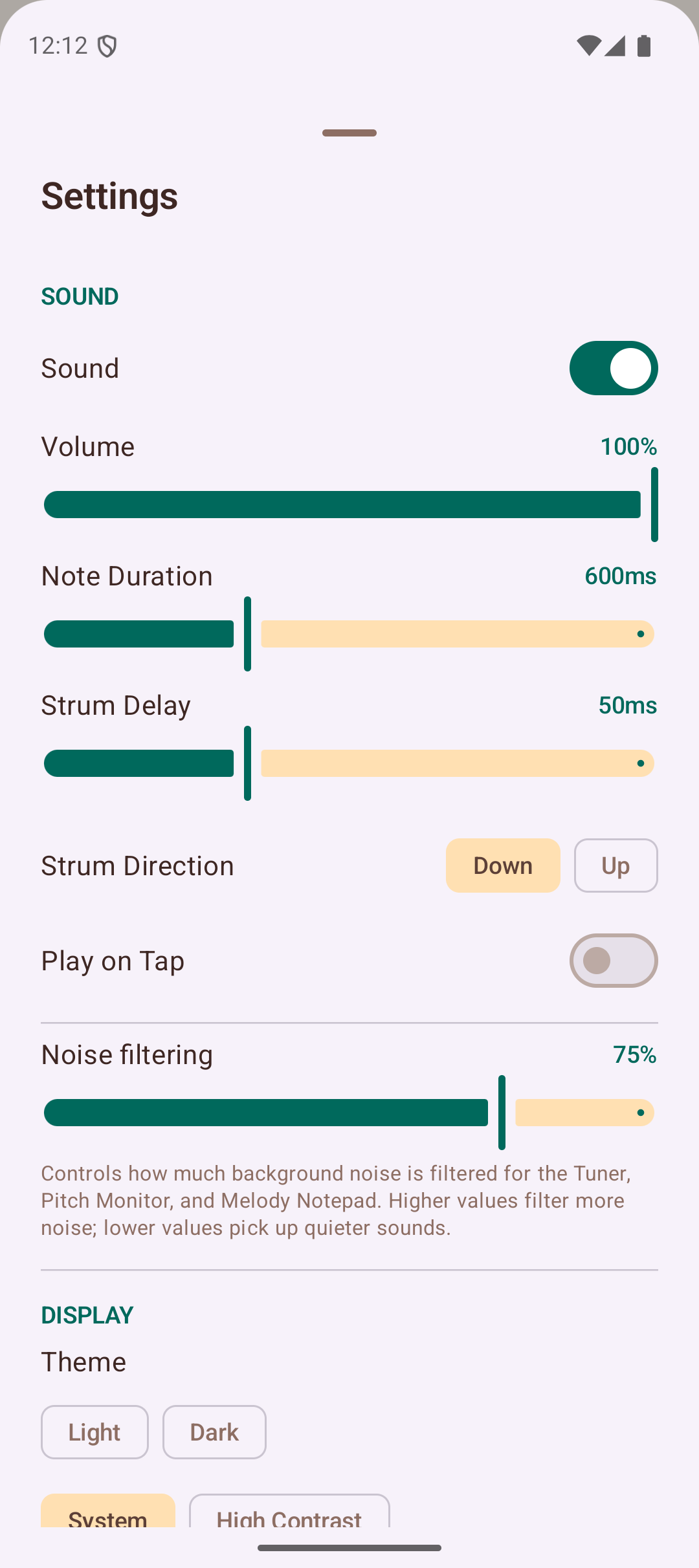
Sound
Control how the app plays back chords and notes.
| Setting | Description |
|---|---|
| Sound enabled | Toggle all sound playback on or off. |
| Volume | Adjust the playback volume from 0% to 100%. |
| Note Duration | How long each note rings out (300–1200 ms). |
| Strum Delay | The delay between strings when strumming a chord (20–150 ms). A shorter delay sounds like a quick strum; a longer delay sounds like a slow arpeggio. |
| Strum Direction | Choose between strumming down (low to high) or up (high to low). |
| Play on Tap | When enabled, plays the note immediately when you tap a fret on the Explorer fretboard. |
| Noise filtering | Controls how much background noise is filtered for the Tuner, Pitch Monitor, and Melody Notepad (0–100%, default 75%). Higher values filter more noise; lower values pick up quieter sounds. Increase in noisy environments or decrease in a quiet room for maximum sensitivity. |
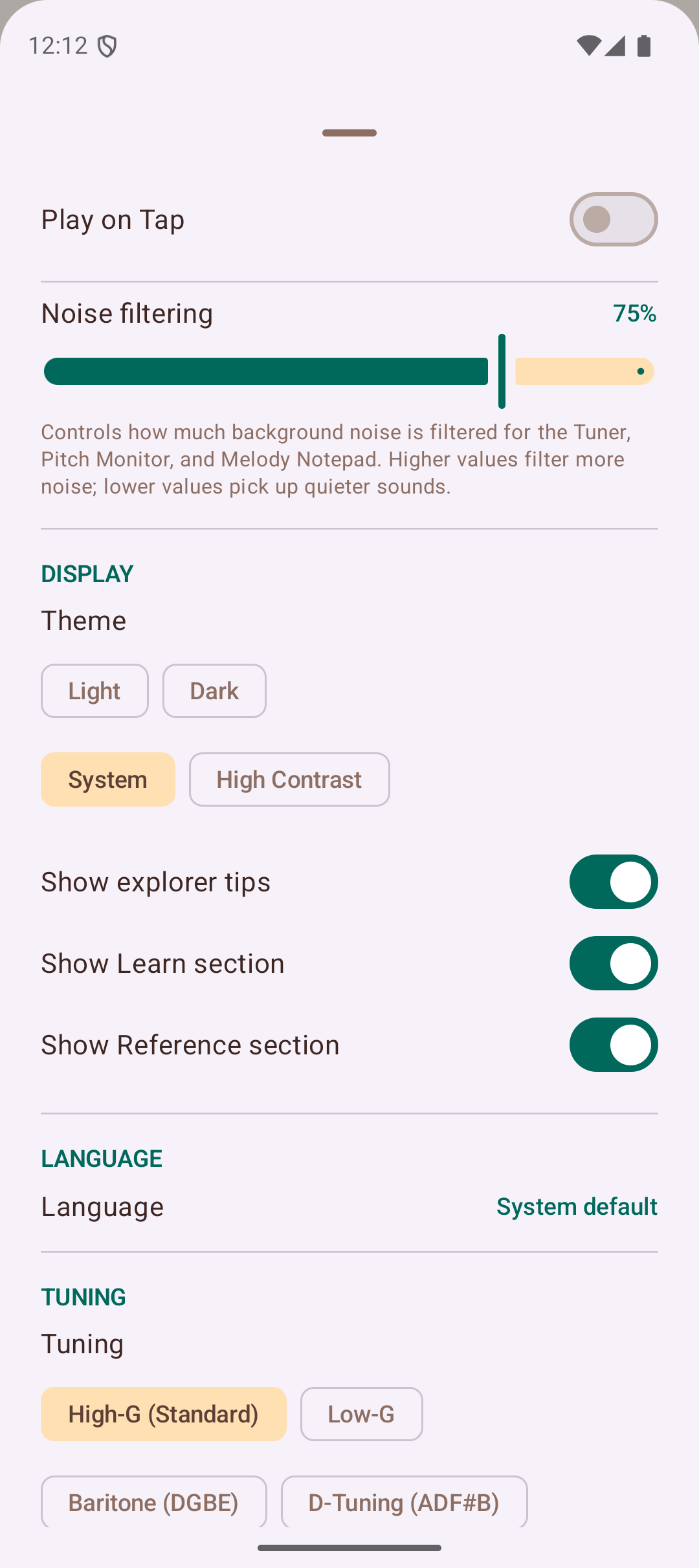
Display
Customize the app's appearance and navigation.
Theme
Choose from four theme options:
| Theme | Description |
|---|---|
| Light | Light background with dark text. |
| Dark | Dark background with light text, easier on the eyes in dim environments. |
| System | Follows your device's system-wide light/dark mode setting. |
| High Contrast | An accessibility-focused theme with stronger color contrast, making text and UI elements easier to read. Adapts to your system light/dark preference. |
Navigation Sections
| Setting | Description |
|---|---|
| Show explorer tips | When enabled, a rotating "Did you know?" card appears on the Explorer tab. |
| Show Learn section | When enabled, the Learn section (Theory, Quizzes, Ear Training, etc.) is visible in the navigation drawer. Disable to simplify the drawer for experienced players. |
| Show Reference section | When enabled, the Reference section (Capo Guide, Circle of Fifths, Glossary, etc.) is visible in the navigation drawer. |
Tuning
Select the tuning for your ukulele. The app adjusts the fretboard, chord detection, and playback accordingly.
| Tuning | Strings | Description |
|---|---|---|
| High-G (Standard) | G4-C4-E4-A4 | The most common soprano/concert/tenor tuning with a re-entrant high G string. |
| Low-G | G3-C4-E4-A4 | Same notes but with the G string tuned an octave lower, extending the bass range. |
| Baritone (DGBE) | D3-G3-B4-E4 | Baritone ukulele tuning, matching the top four strings of a guitar. |
| D-Tuning (ADF#B) | A4-D4-F#4-B4 | A traditional alternative tuning, one whole step above standard. |
Fretboard
| Setting | Description |
|---|---|
| Left-Handed | Mirrors the fretboard so the nut appears on the right side, matching a left-handed player's perspective. |
Tips
- If you play a baritone ukulele, switch to the Baritone (DGBE) tuning so chord detection and playback match your instrument.
- Try the High Contrast theme if you find the default colors hard to read, especially in bright sunlight.
- Adjust the volume slider independently from your device volume for finer control over playback loudness.
- Disable the Learn and Reference sections if you want a simpler navigation drawer focused on playing and creating.